



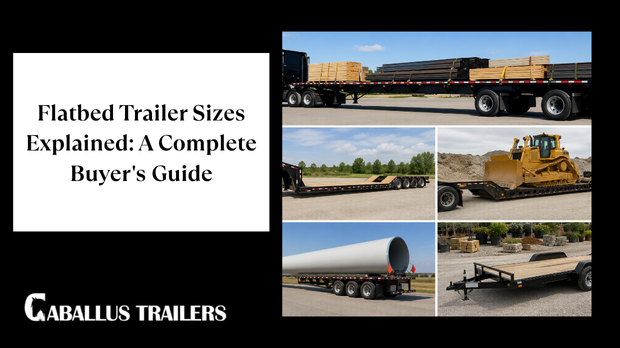
Whether you’ve ever tried to carry heavy equipment, construction materials or over-sized loads, you understand the need to choose the right trailer. But when it comes to flatbed trailers, size matters. Too small and you’ll find yourself with legal issues and safety concerns. Make it too large, and you’re spending money on gas and upkeep. Therefore, it is one of the cleverest things one could do is to comprehend the dimensions of the flatbed truck rental before purchasing or leasing one.
Let’s take it apart, and make sense of it.
Understanding the Size and Dimensions of Flatbed Trailers
A flatbed trailer is defined as a flat, open platform that doesn’t have any sides or roof and is designed to carry large, heavy or awkwardly shaped items. They are used in the construction, agricultural, logging, manufacturing and freight sectors.
The thing is, flatbed trailer sizes don’t come in one size fits all. Various occupations have varying measurements. The length, width, height and load capacity are all a part of determining if a trailer will be right for your particular hauling requirements. Properly getting these numbers correct can save you from permit issues, overloading fines and damaged cargo.
Standard Flatbed Trailer Sizes You Should Know
When people mention the typical flatbed trailer sizes they are normally talking about size that is used most often in the trucking and logistics industry.
Here are some basics for what is considered “standard”:
- Length: 48 feet and 53 feet are the two most common lengths. The 48-foot trailer is older and still widely used, while the 53-foot version has become the new industry standard for most long-haul freight.
- Width: The standard flatbed trailer width is 8.5 feet (102 inches). This is the maximum width allowed on most U.S. highways without a permit.
- Height: Most flatbed decks sit around 58 to 62 inches off the ground. Legal load height (including the deck) is typically 13.5 to 14 feet.
- Weight Capacity: Standard trailers can handle anywhere from 40,000 to 48,000 pounds of cargo.
These are the numbers that are the basis of most commercial flatbed businesses and knowing them will set expectations.
Common Flatbed Trailer Sizes Broken Down by Type
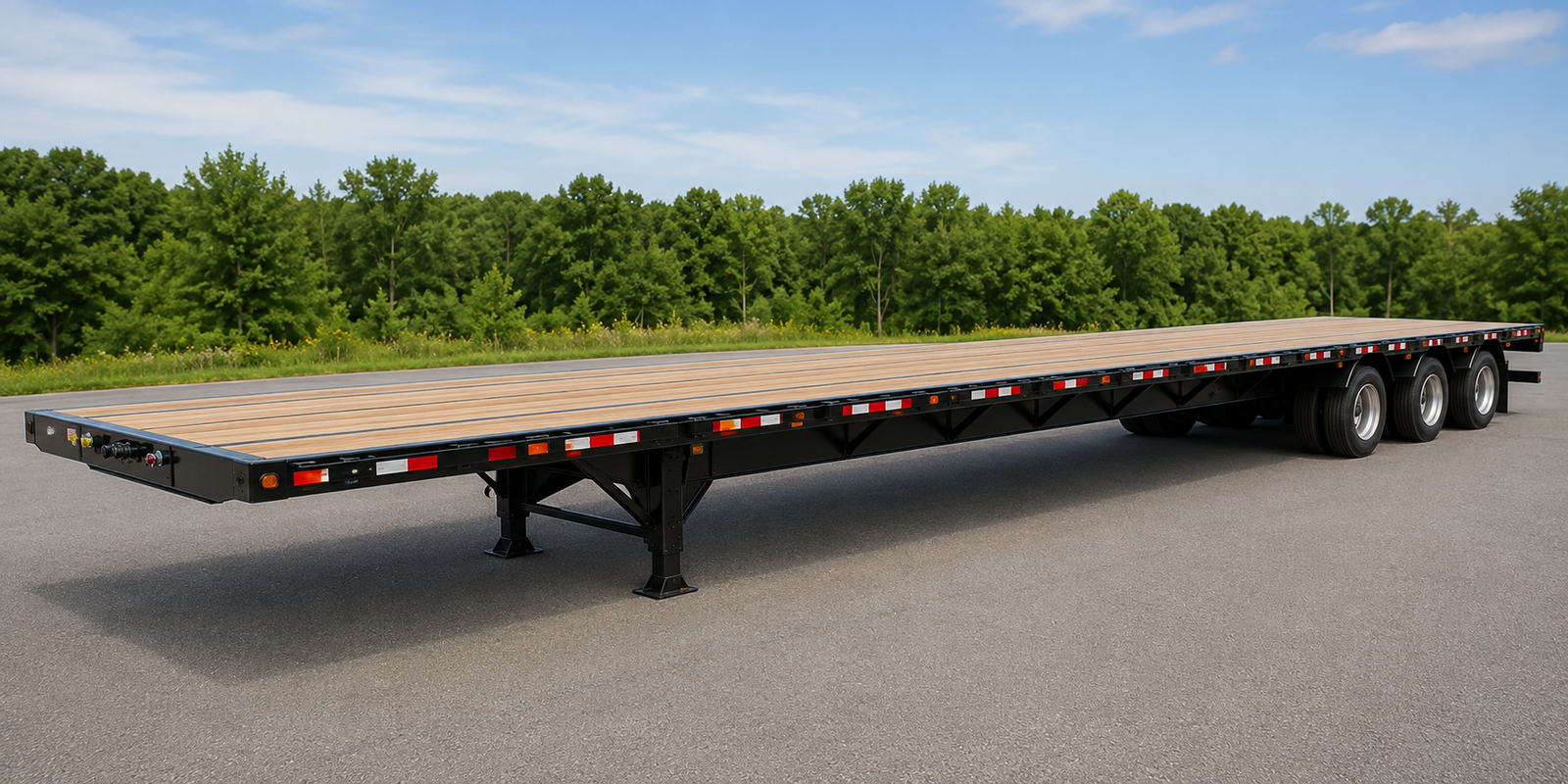
Not all flatbeds are built the same. There are several trailer types under the flatbed category, each with its own common flatbed trailer sizes and use cases.
1. Standard Flatbed
This is your standard “must have” choice. The standard sizes for flatbed trailers are either 48′ or 53′ long, 8.5′ wide, and 5′ high on deck. Ideal for materials, steel, lumber and machines used in construction.
2. Step Deck (Drop Deck) Trailer
A step deck consists of an upper and a lower level. The lower deck is closer to the ground to enable the transport of taller items without exceeding the legal load height limit. The common sizes are 48 to 53 feet overall, and 37 to 40 feet on the lower deck.
3. Double Drop (Lowboy) Trailer
This one slightly dips in the middle. It is especially for extremely heavy and high equipment such as bulldozers, cranes, and industrial equipment. Typically, total lengths are between 29 and 65 ft. depending on the configuration.
4. Extendable Flatbed Trailer
An extendable flatbed is here to lend a helping hand when you need a load that is just too long for a regular trailer. These trailers may be from 48 feet up to 80 feet or greater. They can be used in wind turbine blades, steel beams, and large pipes.
5. Utility Flatbed Trailer Sizes
At the smaller end of the spectrum, utility flatbed trailer sizes tend to be significantly smaller – often from 10 to 20 feet. These are usually employed for landscaping, little building jobs, or personal hauling. They typically are retrieved using pickup trucks or medium-duty trucks.
Must Read: Types Of Trailers: Everything That You Need To Know
Flatbed Trailer Dimensions: The Numbers You’ll Need to Consider
Let’s become a bit more specific about flatbed trailer measurements so you truly know what you’re dealing with.
1. Length
The most common lengths used commercially are 48 ft and 53 ft. The 53′ flatbed offers more space to load, but is more challenging to maneuver in tight spaces. A 48-foot trailer is easier to maneuver and is still readily accepted at loading docks and jobsites.
2. Width
The width of standard flatbed trailers is nearly always 8.5 feet wide. This width is for loads that do not require escort vehicles, oversize load permits or travel windows. An oversize load permit, escort vehicles and sometimes specific travel windows will be necessary if loads expand beyond this width.
3. Deck Height
Flatbed trailer deck dimensions matter more than most people think. A lower deck height means you can haul taller loads legally. Standard flatbeds sit around 58–62 inches high. Step decks drop to around 34–42 inches on the lower section, and double drops can go as low as 18–24 inches.
4. Weight
Don’t overlook payload capacity. Federal bridge laws limit the gross vehicle weight to 80,000 pounds (including the truck). That leaves roughly 40,000–48,000 lbs for the cargo itself, depending on the tractor weight.
How to Choose the Right Flatbed Trailer Size
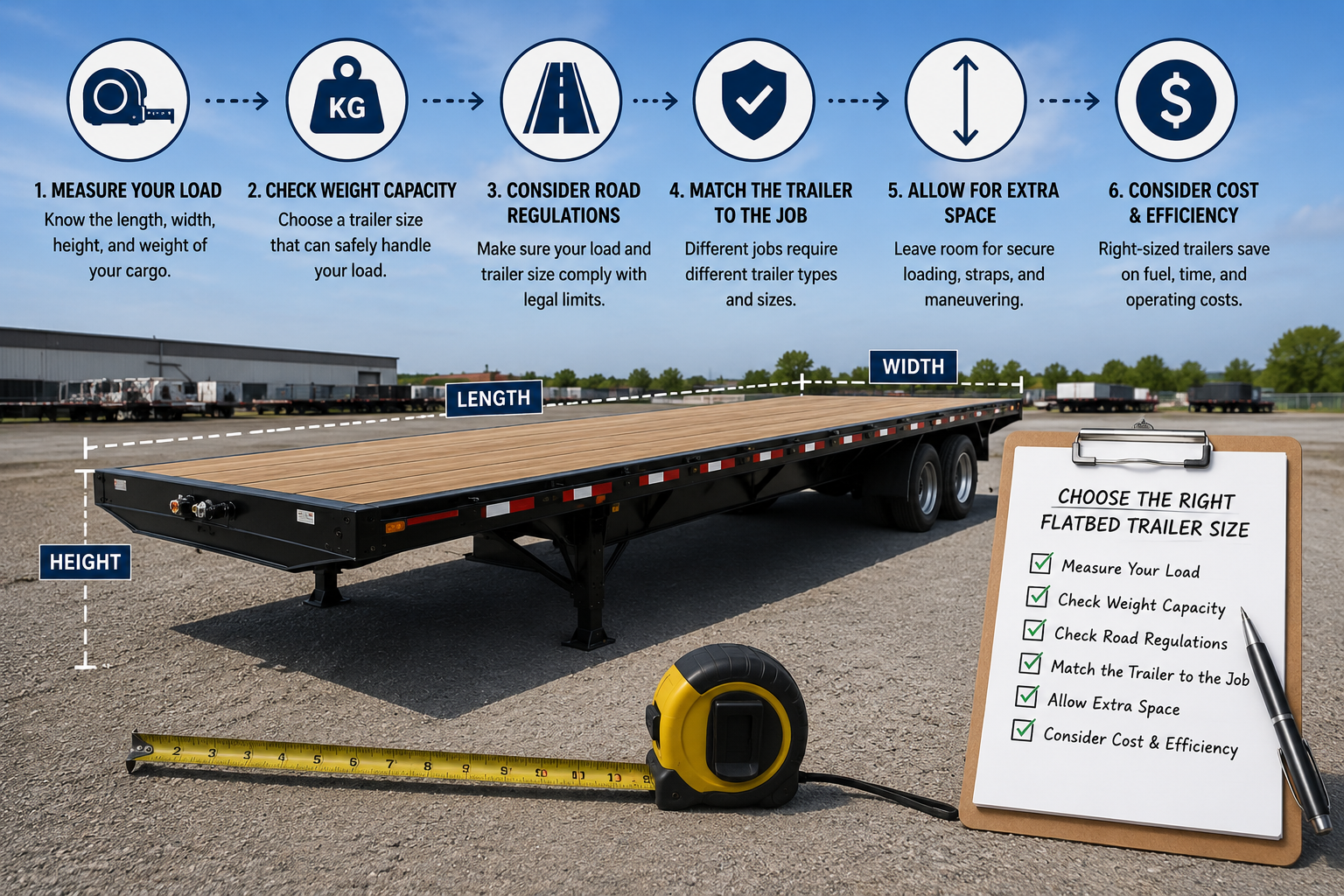
This is the biggest question for buyers to answer and quite simply, it depends on a number of factors. Let’s see how to work it out:
1. Know Your Load
Stick to the load you’re carrying. First measure the length, width, height and weight of your cargo. This is non-negotiable. Your load size will help you eliminate flatbed trailer sizes at once.
2. Check Legal Limits
Every state has a set of trailer size and weight restrictions. Federal standards limit width to 8.5 feet, height to 13.5–14 feet, but some states have additional restrictions. If going across state lines, check state requirements.
3. Consider Frequency of Use
Do you have an ongoing requirement for hauling different loads or the same load over and over? If you’re moving the same type of equipment all of the time, you can get the best out of your load. For loads that are different shapes, sizes, and weights, a standard flatbed with 48/53 feet may work best for you.
4. Consider Maneuverability
Extended trailers are more difficult to back into a loading ramp or job site. A shorter trailer could save you a lot of headaches if you’re working in an area that is predominantly urban, or if you are in a tight spot a lot of the time.
5. Budget Matters
The larger the trailer, the higher the price — to purchase, insure and maintain. For lighter, local hauling, utility flatbed trailer sizes are much less expensive. Only scale when your business really needs it.
Flatbed Trailer Width and Length For Oversized Loads
However, the standard flatbed trailer sizes will not always do the job. If you are handling loads which are larger than standard size, you are in oversized load territory. In practice, this translates to:
- Oversized vehicles (over 8.5 feet): Use oversize permit and escort vehicles (pilot cars)
- Over 13.5 feet tall: The same offer is made — permits and possibly route surveys
- Travel time restrictions: If the length is over 53 feet, then typically a permit is needed and travel time restrictions will apply.
- Grossing more than 80,000 lbs: May require special permits and a special route that has good bridge ratings
In these cases, step decks, extendable flat beds and lowboys are the best choices. Avoid expensive delays and fines by planning ahead for permits.
Final Thoughts
Knowing the size of flatbed trailers is not simply a technicality; it’s a practical approach to business. If you’re a long-time fleet operator or purchasing your first trailer, it can save you time, money and a lot of frustration on the road to get the size right the first time.
In short: The most frequently used flatbed trailer configurations for commercial vehicles are 48 and 53 feet lengths, 8.5 feet wide and 58 to 62 inches high. However, a step deck, lowboy or extendable option may be more suitable, depending on your load. Instead of a trailer to match the job, configure the trailer to the cargo dimensions and then refer to your state regulations.
The one thing you should take away from this guide is the following: measure twice, haul once.
FAQs
Q1. What is the most common flatbed trailer size?
The 53′ flatbed is the most popular truck size in commercial trucking today. It is the largest type of truck available within the standard U.S. highway dimensions, and does not require special permits for use.
Q2. How wide is the standard flatbed?
The width of a standard flatbed trailer is 8.5 feet (102 inches). Any load wider than this must have an oversize permit and possibly escort vehicles depending on the state.
Q3. What is the typical load capacity of a flatbed truck?
A typical flatbed will hold 40,000 to 48,000 lb of cargo. The Federal Law places a limit of 80,000 lbs on gross vehicle weight (truck and trailer and load) on interstate highways.
Q4. What is the difference between a 48-ft and 53-ft flatbed trailer?
The 53′ trailer has more cargo space and is now the industry standard. Although slightly larger at 48 ft, the easier-to-maneuver model is still very popular, particularly in situations that have limited loading dock access or site space.
Q5. What are the regulations for oversized flatbeds?
Yes. An oversize or overweight permit is required if your load is more than 8.5 ft wide, 13.5 ft high, 53 ft long or is more than 80,000 lbs gross weight; this is state and route dependent.
About Author:

Leave a Reply