



If you regularly move equipment or bulk material, it is imperative to know your double-axle trailer’s capacity; otherwise, you won’t recognize whether you are overloading it. This could be hazardous and prove costly. Here’s what you should know about how axle ratings affect double-axle trailer weight capacities.
About the Double-Axle Trailer
Also known as the tandem axle trailer because of its two axles, the double axle trailer has its axles at the rear of the trailer, unlike single axle trailers, which have a single axle. The dual design boosts stability and overall load-carrying capacity. You can mount a tandem on a utility trailer, car hauler, flatbed or enclosed cargo trailer. It carries heavier loads than the single axle.
Double-Axle Weight Capacity Matters
The maximum weight the trailer is planned to safely carry is encompassed in the double-axle trailer weight capacity. Anything other than that, the frame loads up, the tyres blow out, and the brakes fail. Additionally, you could be penalized during DOT inspections. That is why it is imperative that you know the trailer’s capacity as a first step to efficient hauling.
Protect your investment while staying in compliance with state and federal laws through safe, efficient hauling. This is made possible only when you know your trailer’s capacity.
Trailer Vocabulary
Here is some vocabulary you must be familiar with when dealing with double-axle ratings.
- GVWR: Gross Vehicle Weight Rating, the maximum total weight including the truck, trailer and cargo. You should be aware of the tandem-axle trailer GVWR provided by the manufacturer.
- Payload: The actual weight that can be loaded onto the trailer. The formula is GVWR – trailer curb weight.
- Axle Rating: The weight rating of all axles. The sum of the limitations on both axles may be considered as the weight limit if the tandem axles are on a dual-axle trailer.
- Tongue Weight: The rear midsection of the tow vehicle experiences a downward force exerted by the trailer.
Weight Capacity Ranges For The Double Axle Trailer
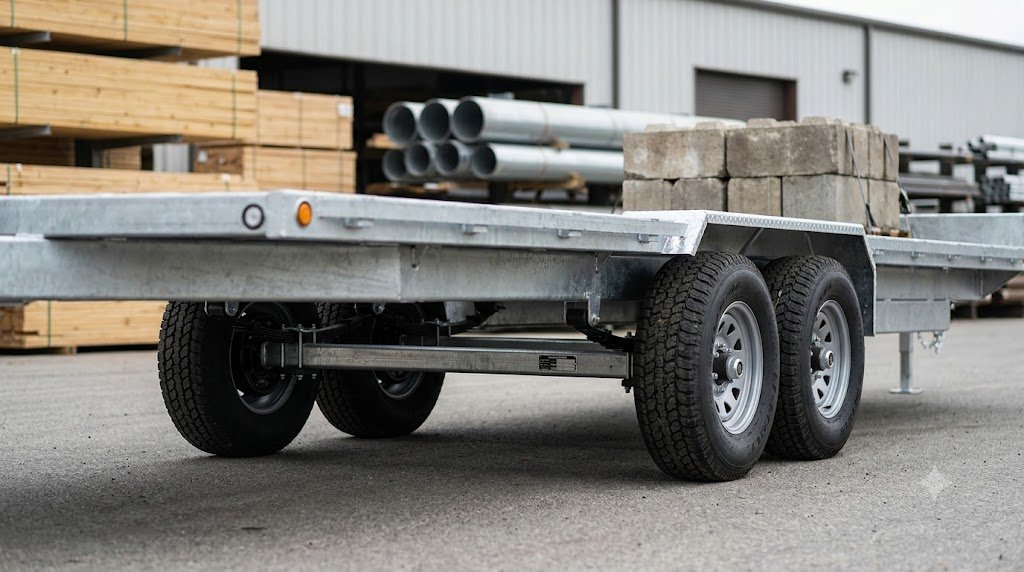
The double-axle weight capacity depends on the type of trailer, the trailer frame construction, and the weight ratings of the axles.
- Light Duty Tandem Axle: These feature two 3500lb axles totalling about 7,000 lbs. Typical trailer loads range from 5,500 to 6,500 lbs, and tandem axle trailer GVWRs range from 7,000 lbs onwards.
- Medium Duty Tandem Axle: Equipped with two axles, 5,200 lb to 6,000 lb axles, totalling 10,400 lb to 12,000 lb tandem axles. These are primarily used to haul bigger utility trailers.
- Heavy-Duty Tandem Axle: These trailers are commercial-grade and have two 7,000- to 10,000-lb axles, with a combined load capacity of about 14,000 to 20,000 lbs or more on the utility trailer.
Must Read: Determine the carrying capacity of trailers
How Axle Ratings Affect Double Axle Trailer Weight Capacity?
It is important to adhere to axle ratings on the double-axle trailer. Failure to do so can invite hefty DOT fines or out-of-service orders. Besides, your trailer could suffer mechanical failures like blown tires, snapped axles and other safety risks when you lose control of the trailer.
Here are some critical issues you could face:
- Legal Consequences: Portable weigh stations are used by the DOT to check double-axle loads. These should not exceed 34,000 lbs across federal interstates.
- Damage: Comply with the standard 60/40 rule, where 40% of the cargo weight is loaded behind and 60% in front of the tandem axle center. Extreme or uneven loads could ruin tires, bend axles and strain the vehicle’s braking and transmission systems.
- Safety: The trailer’s center of gravity and handling are compromised, leading to trailer sway, loss of traction and long stopping distances. The trailer could be in an accident if the weight is overlooked.
Choosing between the Double Axle vs the Single Axle
If occasional loads are less than 4,000 lbs and limited maneuvering is required, then you can use a single-axle trailer. When you haul over that limit, a dual-axle trailer is advised. With tandem-axle trailers, you have greater braking capacity, minimal trailer rollover, tyre usage redundancy and greater payload capacity. The tandem investment is best in the long term, especially if you are a frequent or professional hauler.
Final Thoughts
The first step to safe, legal, and efficient hauling is to manage the double axle trailer weight capacity effectively. It is essential that you properly understand your tandem axle capacity and honour all rated limits within the tandem system, whether you are moving equipment, hauling vehicles or moving materials to a job site. Always stay compliant to prevent losses and save lives. Distribute loads correctly and pick up only suitable loads. Before loading, check your trailer’s GVWR. Perform regular maintenance checks.
FAQs
Q1. What is the carrying capacity of a double-axle trailer?
Typically, tandem axles are available on trailers with GVWR between 7,000 and 14,000 lbs. Heavy-duty units can top out at 20,000 lbs.
Q2. How do you determine the allowable weight for a tandem-axle trailer?
Check the trailer’s frame for the certification label or read the owner’s manual. You can also call the manufacturer with your VIN.
Q3. Can I exceed the GVWR for a vehicle I can tow?
No. Trailer manufacturers preset the GVWR, which must not be exceeded by any tow vehicle.
Q4. What is the relationship between payload capacity and tandem axle capacity?
Tandem axle capacity is calculated as the combined rating of the axles. While payload capacity is GVWR – Trailer curb weight.
Q5. Does each state vary in its trailer weight limit?
Yes. Typically, state-imposed weight limits on public roads are lower than the manufacturer’s.
About Author:

Leave a Reply