




If you’ve ever watched a Class 8 semi grind through a tire set in 60,000 miles instead of 120,000, or wondered why your fuel bills keep creeping up despite no change in load or routes, there’s a very good chance the answer is alignment. Specifically, the lack of it.
Truck and trailer alignment is one of the most financially significant yet consistently underinvested areas of commercial vehicle maintenance. Most fleets don’t think about alignment until they see tire wear that can’t be explained any other way. By that point, the damage — to tires, suspension, fuel economy, and driver experience — is already done.
This guide covers everything you need to know about truck and trailer alignment: why it matters more than most people realize, what the key alignment angles actually are, the different types of alignment machines available, the tools used in a proper alignment job, how to choose the right equipment for your shop or fleet, and the real-world cost of getting this wrong.
Why Truck and Trailer Alignment Is Not Optional
Let’s start with the financial reality before we get into the technical details — because the numbers are what make this topic genuinely urgent for anyone managing commercial vehicles.
Vehicles with correct semi truck alignment experience 47% longer tire life, 5.8% better fuel economy, and 62% fewer alignment-related breakdowns compared to misaligned vehicles. Read those numbers again. Nearly half more tire life. Almost 6% better fuel economy. And that fuel economy figure matters enormously at scale — fuel accounts for nearly 25–30% of fleet operating costs, and misalignment increases rolling resistance, requiring more power and fuel to move the same load. According to industry data, proper alignment can improve fuel economy by up to 2%, especially when combined with correctly inflated tires and balanced loads.
For a fleet running 50 trucks at 120,000 miles per year each, a 2% fuel saving translates to tens of thousands of dollars annually. For a single owner-operator, it’s the difference between a profitable quarter and a break-even one.
A misaligned trailer can put lateral forces on a tractor pulling it down the highway, burning extra fuel, accelerating tire wear, and making drivers work hard. And that last part matters more than people think — driver fatigue caused by constant steering correction is a real safety concern and a growing factor in driver retention decisions.
The bottom line: alignment is not a maintenance checkbox. It’s a direct input into profitability, safety, and equipment longevity.
The Four Key Alignment Angles: What They Mean and Why Each Matters
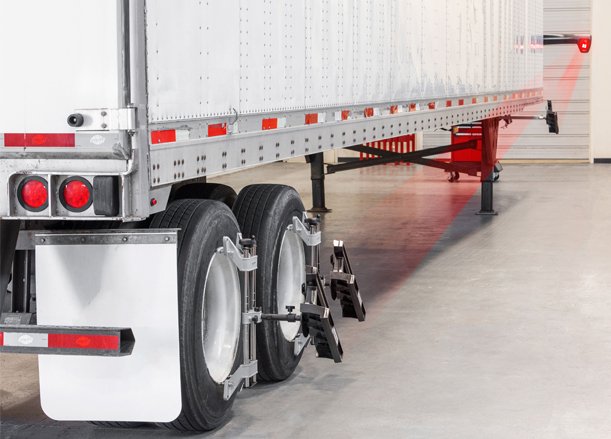
Before you can choose the right machine or tool, you need to understand what alignment actually measures. There are four primary angles in any truck or trailer alignment job, and each one tells a different story about the vehicle’s condition.
Toe: The Most Critical Angle for Tire Wear
Toe is the extent to which tires turn inward or outward when viewed from above. Toe-in alignment is when the front edges of tires are angled in toward one another. Toe-out alignment is when the front tire edges are angled away from one another. Both conditions require adjustment.
Toe is the alignment angle that most directly drives tire wear. Excessive toe-in wears the outside edge of tires, while excessive toe-out wears the inside edge of the tires. If you have excessive toe in either direction, there’s scrubbing of tires. Run your hand across a misaligned tire and you’ll feel a knife-edge in one direction — that’s toe scrub in action, and it’s eating your tire investment mile by mile.
For commercial vehicles, the typical range is 1/16″ to 1/8″ toe-in, with slight toe-in being ideal for stability. Getting this right is the single most impactful alignment adjustment you can make for tire longevity.
Camber: The Inward/Outward Wheel Tilt
Camber is the inward or outward angle of a tire when viewed from the front of a vehicle. Too much inward or outward tilt, also known as positive and negative camber, indicates improper alignment and the need for adjustments. Worn bearings, ball joints, and other components are common causes of camber misalignment.
Positive camber means the top of the wheels tilt away from the truck — useful in some heavy-load applications but may decrease grip in everyday driving. Negative camber angles the tops of the tires inward toward the frame, enhancing grip during turns but increasing wear on the tire’s inner edge.
For most heavy-duty truck applications, neutral or very slight positive camber is the target — enough to keep tires in even contact with the road under load without causing premature edge wear.
Caster: Steering Stability and Driver Feel
Caster is critical for balanced steering, stability, and cornering. Specifically, it is the angle of the tires when viewed from the side of a vehicle. If the tires have positive caster, the steering axis is tilted toward the driver. Negative caster means the steering axis tilts toward the front of the truck.
For commercial vehicles, typical caster range is +2° to +6°, with higher positive caster preferred for straight-line stability. Insufficient caster causes wander and poor return-to-center. Excessive caster creates heavy steering and road shock. Unequal caster side-to-side pulls the vehicle toward the side with less positive caster.
Getting caster right has a direct impact on driver fatigue and vehicle control. It’s also often the alignment angle that shops adjust last — which is a mistake when it has this much influence on the daily driving experience.
Thrust Angle: The Trailer-Specific Challenge
Thrust angle refers to the alignment of the rear axles relative to the front axles. Misalignment here can cause the trailer to track to one side.
The thrust angle is formed by the centerline of the vehicle frame and the direction that an axle points. The TMC target value for scrub (parallelism) and thrust (square) is zero degrees. Both need to be perpendicular to the axle and parallel to one another.
Thrust angle is the heart of trailer alignment specifically. When it’s off, the trailer doesn’t track straight behind the tractor — instead it “dog-tracks,” running at a slight angle to its direction of travel. This creates constant rolling resistance, accelerated tire wear across every wheel end, and a vehicle that never quite feels right to drive.
Types of Truck and Trailer Alignment Machines
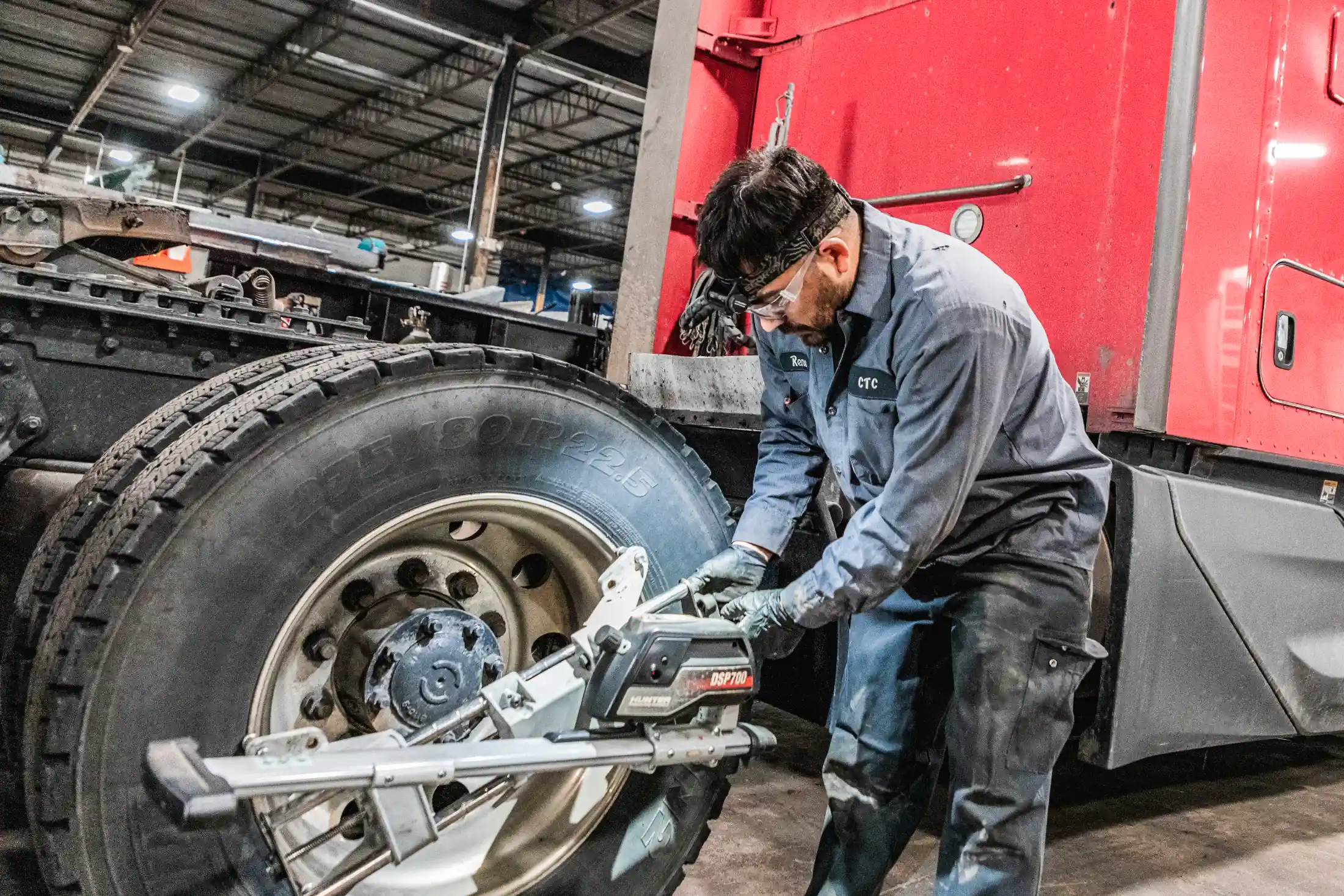
Now that you understand what’s being measured, here’s a breakdown of the main machine types available for commercial vehicle alignment — from the most basic to the most sophisticated.
Laser Alignment Systems
Laser-based systems are the workhorse of the truck and trailer alignment world. They use precisely aimed laser beams projected across the vehicle’s axles to measure angles, offsets, and tracking relationships.
The TLT-12 Heavy-Duty Truck, Bus, RV & Trailer Laser Wheel Alignment System is completely portable, simple to use, and fast. Keeping buses, trucks, and RVs in alignment increases money to the bottom line, extends the life of all tires, and saves fuel.
Laser systems are popular in fleet maintenance operations because they combine accuracy with portability — you can take the system to the vehicle rather than driving the vehicle to a dedicated alignment bay. For fleets maintaining vehicles on-site, this is a significant practical advantage.
Best suited for: Fleet maintenance shops, portable field service, operations without dedicated alignment bays.
3D Camera and Imaging Alignment Systems
3D imaging technology represents the current state of the art in truck and trailer alignment. These systems use multiple high-definition cameras to capture the position of targets mounted on the wheels, then process those images through specialized software to calculate precise alignment angles across all axles simultaneously.
The WS-MobileAlign is equipped with high-definition cameras and advanced 3D imaging technology, ensuring accurate measurements and consistent results — whether used at ground level, on a lift, or over an alignment pit.
Hunter’s truck alignment technology allows technicians to capture heavy-duty wheel alignment readings in three minutes, with easy-to-understand printouts that help sell service. The system sees three axles live simultaneously, reducing setup time through minimal sensor movement.
3D systems are faster and often more accurate than laser systems, especially for multi-axle configurations. The tradeoff is cost — these systems represent a significant capital investment.
Best suited for: High-volume commercial truck shops, franchised dealerships, operations where speed and professional printouts matter.
Computer-Based CCD Sensor Systems
CCD (Charge-Coupled Device) sensor systems use electronic sensors mounted on the wheels to transmit alignment data wirelessly to a central computer. The computer processes the measurements in real time and displays them against manufacturer specifications.
Computerized wheel aligners with CCD-camera sensors and data transmission by radio (2.4 GHz) are prepared for the alignment of heavy vehicles, trucks, trailers, and semi-trailers.
These systems excel at multi-axle work — which is exactly what commercial vehicles demand. Being able to see all axles simultaneously, compare measurements in real time, and follow guided adjustment procedures reduces technician error significantly.
Best suited for: Full-service commercial vehicle repair shops handling a wide range of truck and trailer configurations.
Mobile and Portable Alignment Systems
Unlike traditional alignment systems, the WS-MobileAlign moves effortlessly from bay to bay, allowing technicians to perform alignments wherever needed — designed and engineered for flexibility and mobility in a compact, portable design ideal for shops of any size.
Mobile alignment systems have evolved dramatically. Early portable systems sacrificed accuracy for convenience. Today’s portable units, equipped with the same 3D imaging and wireless sensor technology as fixed systems, deliver professional-grade results without requiring a dedicated alignment bay.
Best suited for: Mobile truck repair operations, fleet yards without service bays, shops needing flexibility across multiple locations.
Leading Alignment Machine Brands Worth Knowing
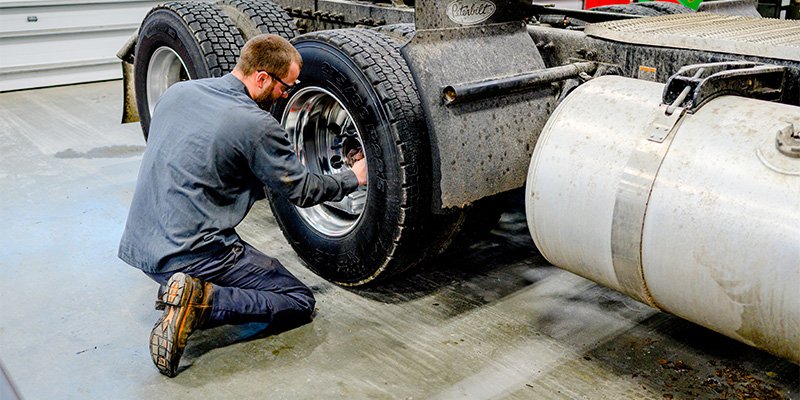
Hunter Engineering
Hunter’s WinAlign® HD software supports more than 60 customized truck, trailer, and bus alignment procedures as well as passenger car and light truck alignment. The system works with all vehicles on the road today, from cars to Freightliners, and can cut adjustment times in half for rear axle corrections.
Hunter is widely considered the premium standard in commercial vehicle alignment equipment. Their systems are found in franchised dealerships, major truck fleets, and high-volume independent shops. The investment is substantial, but the speed, accuracy, and software capability justify it for operations with consistent alignment volume.
Atlas / Ravaglioli
The Ravaglioli “Sprint” is the latest in alignment technology, allowing alignments on trucks, trailers, coaches, buses, and multi-axle vehicles. Atlas and Ravaglioli equipment occupies the mid-to-premium price range and offers solid performance for shops looking for professional capability without Hunter’s price point.
Manatec
Manatec’s JUMBO-3D-SUPER-4A is the world’s first 3D wheel aligner for multi-axle trucks, buses, and trailers. Their portable FOX-3D systems use vision-based 3D imaging technology with two high-performance cameras for simultaneous front and rear wheel alignment.
Manatec has built a strong reputation in the heavy-duty segment specifically, with a product line focused almost entirely on commercial vehicle applications rather than as an add-on to a passenger car alignment portfolio.
Tru-Line
The TLT-12 from Tru-Line is completely portable, simple to use, and fast — suitable for any fleet configuration and made in the USA. The system takes alignment to where the truck, crane, bus, RV, or trailer is located, rather than requiring them to come to a dedicated bay.
Tru-Line specializes in practical, field-deployable alignment solutions — particularly well-suited for fleet operations that need to bring the equipment to the vehicle.
Essential Alignment Tools Beyond the Machine
The alignment machine is the diagnostic and measurement center of a proper alignment job. But it doesn’t work alone. A complete truck and trailer alignment requires a set of supporting tools that make the measurements accurate and the adjustments possible.
Turnplates and Slip Plates
Turnplates (also called turntables) sit under the steer axle tires and allow the wheels to rotate freely during measurement. Without them, the friction between the tire and the floor would prevent the wheels from moving to their natural position, introducing error into every measurement.
For trailers, slip plates serve a similar function under trailer tires. Both need to be the right size for the vehicle’s tire footprint and load capacity.
Wheel Clamps and Adapters
Alignment targets — whether laser reflectors or 3D camera targets — mount to the wheels via clamps and adapters. For heavy-duty work, these clamps need to be robust enough to hold targets securely across the full range of commercial wheel sizes without flex or slip that would invalidate readings.
Hunter’s HD QuickGrip® Adaptors allow for fast installation and no metal-to-metal contact, reducing setup time while protecting wheel surfaces. Quality adapters reduce setup time significantly across a full alignment job.
Alignment Sensors and Targets
Depending on the system type, alignment sensors are either CCD electronic sensors, laser reflector targets, or 3D imaging targets. Each measures the same angles through different technology. The key quality factors are accuracy (measured in arc-minutes), wireless reliability, and battery life for cordless operation.
Hunter’s DSP760T heavy-duty alignment sensors reduce setup time and provide accurate alignment readings, with cordless sensor operation and hot-swappable batteries keeping the work area free of tripping hazards.
Caster/Camber Gauges
For shops that don’t yet have a full computerized alignment system, or for field verification work, standalone caster/camber gauges provide mechanical measurement of these angles. Bubble-type gauges are the most basic. Digital electronic gauges offer higher accuracy and easier reading. They won’t replace a full alignment machine for production work, but they’re valuable diagnostic tools for quick checks.
Toe Bars and Measuring Tapes
Traditional toe measurement tools — toe bars that bridge the gap between two wheels on the same axle — are still used for quick checks and verification. They don’t provide the accuracy of computerized measurement for final alignment specs, but they’re fast, require no setup, and can identify obvious misalignment quickly during pre-trip inspections or post-load checks.
Alignment Pit and Lift Equipment
Using sophisticated measurement tools, such as laser aligners and computer-based diagnostics, mechanics measure the current alignment angles of the truck’s wheels. Advanced systems might also measure the thrust angle and other parameters that influence how the truck handles on the road.
A proper alignment bay requires either a drive-over pit or a suitable surface-level setup that gives technicians access to wheel ends and suspension adjustment points while the vehicle remains in a loaded or representative position. Alignment lifts designed for commercial vehicles — with the weight capacity and platform dimensions to handle Class 6–8 trucks — are a significant infrastructure investment but enable more thorough adjustment access.
Choosing the Right Alignment Machine for Your Operation
Not every shop or fleet needs the same equipment. The right choice depends on several practical factors.
Volume and Throughput
High-volume shops need speed. If you’re turning 15–20 alignment jobs per day, a 3D imaging system that completes a three-axle measurement in under four minutes is worth every dollar of its premium over a slower laser system. For a shop doing five alignments a week, a quality laser system may be perfectly adequate.
Vehicle Mix
Hunter’s WinAlign® HD works with all vehicles on the road today, from cars to Freightliners. If your shop handles both passenger vehicles and commercial trucks, a system with both capabilities avoids the need to maintain separate equipment. If you work exclusively with Class 6–8 trucks and trailers, a dedicated heavy-duty system optimized for that range will typically offer better capability at a lower cost than a universal system.
Shop Layout and Bay Availability
Fixed alignment systems require a dedicated bay — typically a flat, level surface at least 60 feet long to accommodate a full tractor-trailer combination. If you don’t have that space, a portable or mobile system is your answer. The WS-MobileAlign delivers precise alignment performance in a compact, portable design — ideal for shops of any size.
Budget Considerations
Entry-level laser alignment systems for heavy-duty trucks start around $5,000–$8,000. Mid-range 3D systems with comprehensive software run $15,000–$30,000. Premium systems from Hunter, with full software, training, and support packages, can exceed $50,000. For most independent shops, a mid-range 3D system offers the best balance of capability, speed, and return on investment.
Signs That a Truck or Trailer Needs Alignment
Recognizing the signs of misalignment before they compound into expensive problems is a core fleet management skill.
Feathering is a wear pattern where the tire tread is smooth on one side but sharp and well-defined on the other — usually a sign of poor toe alignment. Camber wear appears when the inside or outside of a tire is noticeably more worn than the centerline of tread. Heel and toe wear occurs when one side of a tire’s tread blocks wears faster than the other in a circumferential direction.
Beyond tire wear, the behavioral signs include:
- Vehicle pulling — the truck consistently drifts to one side without steering input
- Steering wheel off-center — the wheel is not centered when driving straight
- Dog-tracking — the dump trailers visibly runs at an angle to the tractor when viewed from behind
- Driver complaints — drivers reporting the vehicle requires constant correction to hold a lane
- Vibration at highway speed — particularly steering wheel vibration that worsens above 55 mph
Fleets operating on rugged terrain or in tight urban delivery zones should consider quarterly alignments due to higher exposure to impact-related misalignments. Highway fleets with consistent routes and minimal curb strikes can typically extend to semi-annual alignment checks — but checking more frequently costs far less than the tire sets and fuel you lose by checking too infrequently.
Building an Alignment Program for Your Fleet
A reactive alignment approach — only aligning after visible tire wear develops — is expensive. A preventive alignment program pays for itself.
The core elements of a sound fleet alignment program:
Establish a baseline. Align every vehicle in your fleet to spec and document the results. This establishes what “correct” looks like for each vehicle configuration.
Set inspection intervals. For most highway fleets, a full alignment check every 100,000 miles or annually — whichever comes first — is a reasonable starting point. Adjust based on operating conditions and your tire wear data.
Train drivers to report. Drivers are your earliest warning system. A vehicle pulling to the right or requiring constant steering correction should trigger an alignment inspection before the next scheduled interval.
Track tire wear by position. Systematic recording of tread depth by wheel position across your fleet reveals alignment patterns — specific axle positions or vehicle configurations that consistently wear faster than others.
Include trailers. Trailer alignment is often neglected because trailers don’t have an operator noticing the pull or the steering feel. In operations where trailers are swapped frequently, uniform alignment becomes a key concern — misaligned trailers can cause even properly aligned tractors to develop tire wear or steering drift.
Frequently Asked Questions
1. How often should trucks and trailers be aligned?
Most highway fleets should perform a full alignment check every 100,000 miles or annually, whichever comes first. Fleets operating in urban environments, on rough roads, or with frequent loading/unloading cycles may need quarterly checks. Alignment should always be checked after any significant impact — pothole strike, curb contact, or accident — regardless of schedule.
2. What is the difference between a 2-axle and multi-axle truck alignment?
A 2-axle alignment covers the steer axle and one drive axle, measuring toe, camber, caster, and thrust angle. Multi-axle alignment extends this to tandem drive axles and trailer axles, measuring parallelism and tracking relationships between all axles simultaneously. Multi-axle alignment requires equipment specifically designed for the task — a standard 2-axle system cannot accurately measure tandem axle relationships.
3. Can I align a trailer separately from the tractor?
Yes, and it’s often recommended. Trailer alignment focuses on axle toe, camber, and thrust angle relative to the trailer frame and kingpin. A properly aligned trailer should track directly behind any correctly aligned tractor. In practice, tractor and trailer alignment are best checked together to confirm the combined vehicle tracks correctly.
4. What’s the difference between a laser alignment system and a 3D imaging system?
Laser systems project beams across axles to measure angles and are typically more affordable and portable. 3D imaging systems use cameras to capture wheel target positions and calculate angles through image processing, offering faster measurement, higher accuracy on multi-axle vehicles, and better software-guided adjustment procedures. For high-volume commercial work, 3D systems offer meaningfully faster throughput.
5. How much does a commercial truck alignment cost at a shop?
A professional truck alignment at a service shop typically ranges from $150 to $400 for a single steer axle, with full tractor-trailer alignments running $300 to $600 or more depending on vehicle complexity and regional pricing. For fleets doing alignment in-house, the cost per alignment drops significantly once equipment investment is amortized — often below $50 per alignment including technician time.
About Author:

Leave a Reply